
Emergency Roof Repair Near Me: What Mission Viejo Homeowners Should Do First
If you’ve got water coming through your ceiling in Mission Viejo right now, the first call you make should not be to a roofer. It should be to whoever is standing in your house, because the next 90 minutes determine whether this is a $600 patch job or a $12,000 mold and sheathing replacement. The sequence matters: contain the water inside first, document everything second, call your insurer third, and then call a contractor. Skip any of those steps and you’re handing your insurance adjuster a reason to deny the claim. If you’d rather not manage this alone, call us at (855) 707-6114 and we’ll walk you through it while we head your way.
The 90-Minute Window: Why Order Matters More Than Speed
Most Mission Viejo homeowners react to a roof leak the way you’d expect: they grab a bucket, then start frantically Googling “emergency roof repair near me.” That’s understandable, but it’s backwards. Here’s the sequence that actually protects you financially:
- Interior containment (minutes 0 – 15). Move furniture, electronics, and anything porous out of the water’s path. Water spreads sideways through drywall faster than it drips. A ceiling that shows a 6-inch stain has likely already wicked moisture 18 to 24 inches in every direction. Put down plastic sheeting, not just towels. Towels saturate in minutes.
- Documentation (minutes 15 – 40). Photograph everything: the wet ceiling, the walls, the floor, the attic if it’s safe to peek up there, and the exterior roof area above the leak. We’ll cover exactly what your insurer needs in a moment.
- Insurer notification (minutes 40 – 60). Call your homeowner’s insurance. Not next week. Not after a contractor “takes a look.” The claim needs to be opened while the damage is fresh and the evidence is intact.
- Contractor call (minutes 60 – 90). Now you call a roofer. By this point you’ve secured the evidence trail and the claim number, which means you can talk to the contractor about mitigation instead of asking them to help you reconstruct what happened.
We’ve seen this play out in neighborhoods all over Mission Viejo, from Casta del Sol to Pacific Hills. The homeowners who followed this order kept their claims clean. The ones who called us first and had us on site before documenting a thing? They spent weeks fighting adjusters who wanted proof the water intrusion existed before anyone touched it.
What Mission Viejo’s Climate Does to a Damaged Roof
Here’s what most generic roofing advice misses: Mission Viejo’s weather pattern creates a tighter damage timeline than you’d get in, say, Phoenix or Las Vegas. It’s not just the rain. It’s the marine layer.
During the fall and winter, the overnight cloud layer that rolls in off the Pacific sits right on top of Saddleback Valley. Humidity levels spike. That means any water that gets past your roof barrier doesn’t dry out the way it would in a desert climate. It lingers. Plywood sheathing absorbs it. Attic insulation acts like a sponge. Within 48 hours you’ve got ideal conditions for mold growth in the attic, and mold doesn’t care that you’re waiting for the insurance adjuster to call back.
We also get Santa Ana wind events every fall. Those winds don’t just tear shingles off. They lift the leading edges of shingles that were already compromised, breaking the sealant strips and letting water slide underneath weeks or months before the next real rainstorm arrives. A homeowner with a roof that survived last season can get hit this season from damage that’s been hiding since October. Mission Viejo’s mix of steep tile roofs in the hills and comp shingle roofs in the flatter tracts means no two wind-damage patterns look the same.
If you’ve got active water intrusion, assume the clock is running faster here than the national average. Sheathing that would take a week to grow mold in Denver can start showing signs in three days in Mission Viejo. That’s not an exaggeration, it’s what we’ve documented in attics across Lake Mission Viejo and along Marguerite Parkway.
How to Tarp a Roof Without Voiding Your Claim
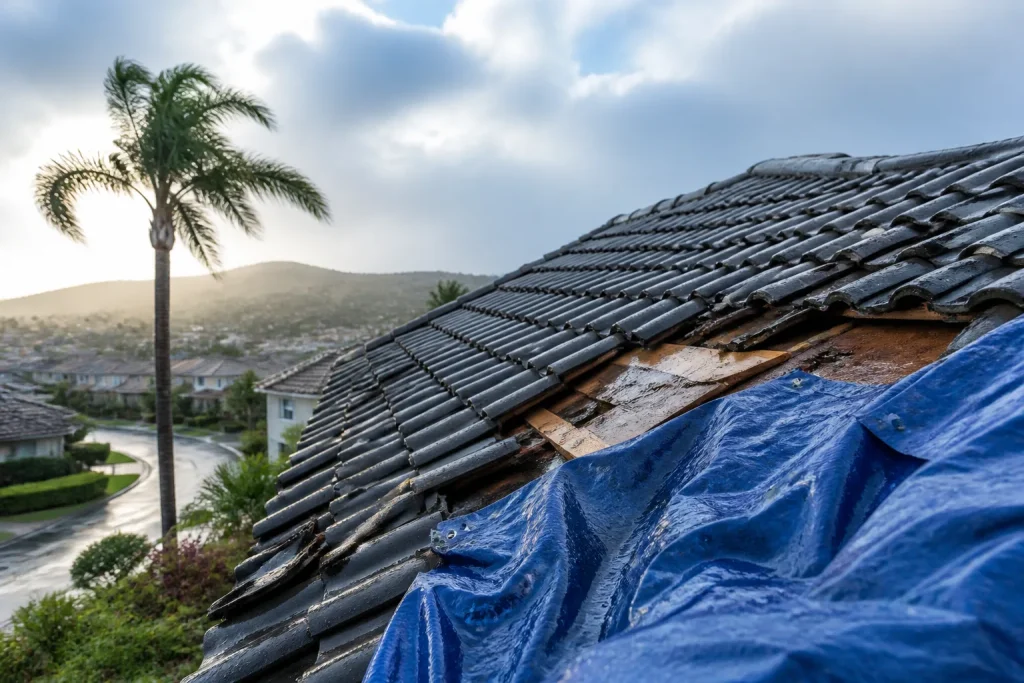
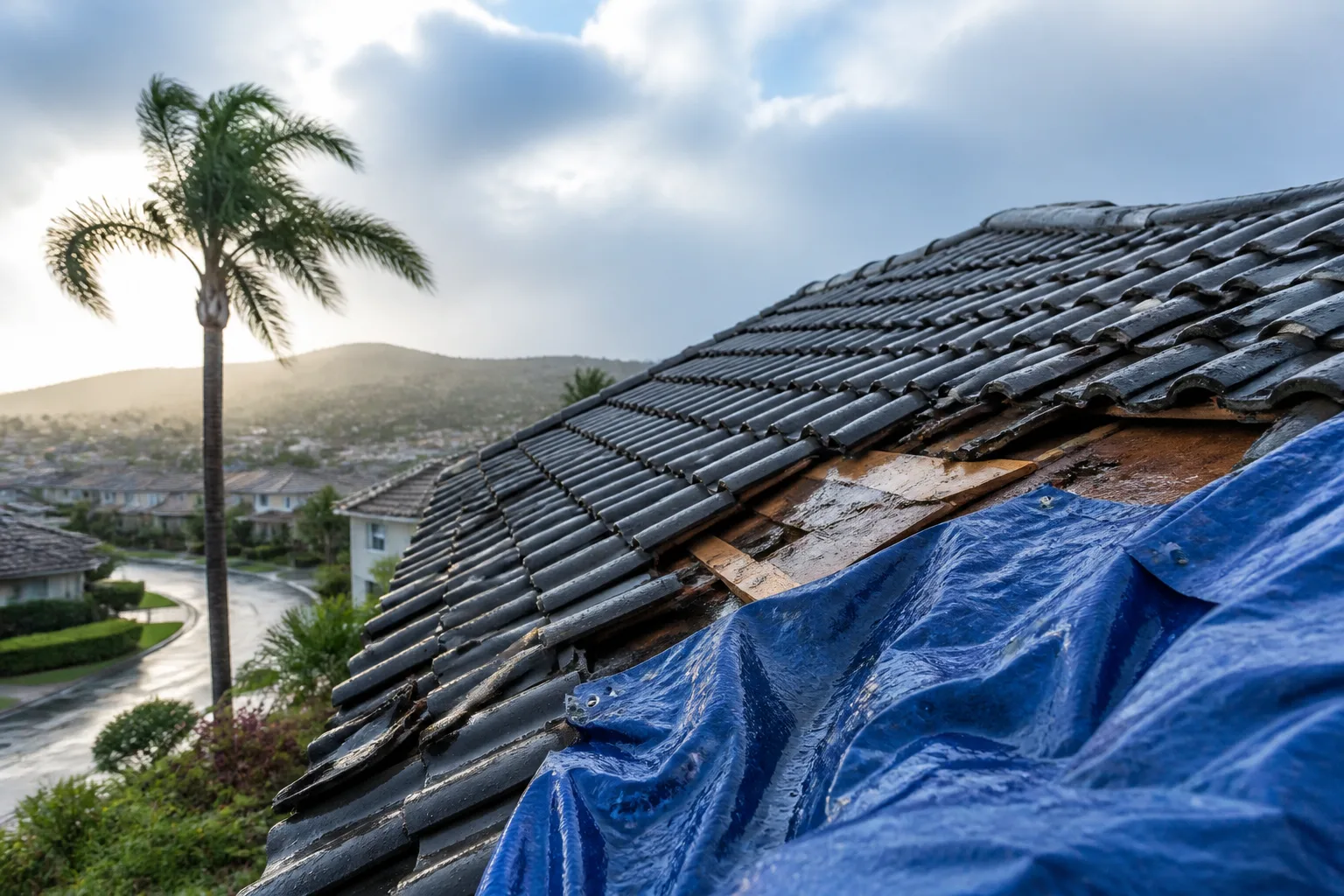
Emergency tarping is one of those things that sounds simple and goes wrong fast. On a Mission Viejo roof with a typical 4/12 to 6/12 pitch, a loose tarp becomes a sail in the same Santa Ana winds that caused the damage. It can tear off more shingles, slam into your neighbors’ windows, or worse, pull someone off the roof trying to secure it.
Here’s what actually matters:
- Document before you tarp. Photograph the damaged area first. Your insurer needs to see the pre-tarp condition. If you cover it up before photographing, the adjuster can’t verify the damage and may question whether the tarp was even necessary.
- Tarp over the ridge if possible. Water runs downhill. A tarp that only covers the damaged section and not at least 3 feet past the ridge will channel water underneath it and into the house anyway. The tarp needs to extend far enough up the slope that runoff flows over it, not under it.
- Use furring strips or 2x4s, not rocks or bricks. We’ve pulled tarps out of Mission Viejo gutters that were anchored with cinder blocks. That doesn’t hold, and it’s a projectile hazard during the next wind event.
- Never walk on a wet tile roof. Mission Viejo has thousands of homes with concrete or clay tile. Wet tile is slippery regardless of what kind of shoes you’re wearing. If you have tile, call a professional. Period.
We regularly get calls from homeowners who tried the DIY tarp route and made things worse. It’s not a judgment. It’s just that roofing materials and wind physics interact in counterintuitive ways. A tarp installed in the wrong sequence or without the right anchoring can double the repair cost and give your insurer a foot in the door to argue that the tarp, not the original storm, caused the secondary damage.
The Five-Minute Vetting Process: How to Spot a Storm Chaser
After every Santa Ana event, the storm chasers appear in Mission Viejo. They’ll have a truck, a magnet sign, and a persuasive pitch about “emergency pricing” that expires if you don’t sign today. Here are the three questions that separate legitimate local roofers from the crews that will be gone before your next insurance check clears:
- 1
“What’s your local address and how long have you been roofing in Orange County?” A real local company has a physical address and a history you can verify. Storm chasers work out of hotel rooms and rented trucks. Ask for a business card, then check the address on Google Maps later.
- 2
“Which shingle brands are you certified to work with?” This question trips up the storm chasers immediately. They either don’t know what’s on your roof or they claim they can work on anything without being able to name a single manufacturer. We work across seven of the industry’s top brands, including Tamko, Boral, and CertainTeed. That’s not a brag, it’s a diagnostic advantage: we can match the material, not just patch over it.
- 3
“Will you provide a written, line-item estimate before any work begins?” Storm chasers hate this question because their whole model is vague verbal pricing that grows once the work starts. A legitimate roofer gives you a written quote with specific materials, specific labor, and a defined scope.
If the answer to any of these is evasive, hang up. There are enough solid roofing companies in Mission Viejo that you don’t need to gamble on a stranger with a ladder.
What to Photograph (And What Insurers Actually Care About)
The documentation step is where most Mission Viejo homeowners undermine their own claims. They take 40 blurry photos of the same wet drywall spot and zero photos of the roof itself. Here’s the order that actually helps an adjuster process your claim:
- Interior water entry points first. The ceiling stain, the wall streak, the pooling on the floor. These establish that water entered the home and where.
- The attic, if accessible and safe. Photos of wet insulation, dripping sheathing, or active water tracks. This connects the roof damage to the interior damage. Without attic photos, adjusters sometimes argue the interior water came from a plumbing leak, not the roof.
- The exterior roof surface. Missing shingles, lifted edges, cracked tiles, visible underlayment. Use a zoom lens from the ground if you can. Don’t climb onto a damaged roof for photos, especially a wet one.
- The surrounding area. If a tree limb came down, photograph the limb and where it hit. If wind was the cause, photograph your neighbors’ roofs if they show similar damage. This establishes a weather event pattern.
We’ve worked with enough adjusters on Mission Viejo claims to know what they flag. The claim that gets approved quickly is the one with a clear photographic chain: water entered here, came from here, caused by this exterior damage. The claim that gets bogged down is the one with 40 photos of the same bedroom ceiling and nothing else.
When to call a pro: if you’re dealing with a tile roof, a steep pitch, an active electrical hazard (like water running near a ceiling fan or light fixture), or any damage you can’t fully see from the ground. Some things aren’t worth the risk. Emergency tarping on a wet tile roof is definitely on that list.
Related services in Mission Viejo: if this leak turns out to be the symptom of an aging roof rather than a one-time event, we also provide roof replacement in Mission Viejo and standalone roof inspections in Mission Viejo when you need an honest assessment without a sales pitch attached. And if the damage is limited to a small area, our roof repair team in Mission Viejo handles the fix.
The Bottom Line
Emergency roof damage in Mission Viejo is a race between you, the water, and the insurance claim process. The order of operations matters: contain, document, notify, then call a contractor. Do it in that sequence and you’ve protected your home and your claim. Do it out of order and you’re fighting an uphill battle with an adjuster while your attic grows mold.
The marine layer and Santa Ana winds mean Mission Viejo roofs fail differently than roofs in most of Southern California. Getting someone who knows those failure patterns, and who works with the brand already on your roof rather than pushing whatever’s in their warehouse, makes the repair faster and the result more durable.
If you’re in Mission Viejo and dealing with active roof damage, Briarwood Roof Repair offers free estimates. Call (855) 707-6114 and we’ll help you figure out what you’re dealing with, whether that’s emergency tarping, a repair, or a full assessment. More about our approach on the Briarwood Roof Repair home page.
Frequently Asked Questions
Emergency roof repair in Mission Viejo typically costs between $450 and $850 for a basic tarp and temporary patch, while a permanent repair for missing shingles or a small leak usually runs $600 to $1,800 depending on the roof material and the extent of water damage. Tile roofs are generally more expensive to repair than comp shingle roofs because of the material cost and the care required to remove and reset tiles without breaking surrounding ones. Call (855) 707-6114 for an exact quote, estimates are free.
Most Mission Viejo homeowners’ policies cover sudden, accidental roof damage from events like wind, rain, or falling objects, but coverage depends on your deductible and the policy terms. The key is documentation: claims with clear photos taken before any temporary repairs are far more likely to be approved. If you tarp before photographing, you risk the adjuster questioning the scope of the original damage. Call (855) 707-6114 if you need help assessing what should be documented.
In Mission Viejo’s marine layer climate, a roof leak can start causing secondary damage to sheathing and insulation within 48 to 72 hours. The overnight humidity from the Pacific slows evaporation, keeping moisture trapped in the attic. If you’ve got active water intrusion, aim to have it tarped or patched within 48 hours. Waiting longer than that risks mold growth and turns a $600 repair into a much larger remediation project.
Yes, and this is one of the biggest advantages of working with a roofer who isn’t locked into a single brand. We work across seven major shingle manufacturers, including Tamko, Boral, and CertainTeed, which means we match the material that’s already on your Mission Viejo roof rather than patching it with whatever’s in stock. Material-matched repairs blend better visually and preserve the integrity of the existing roof system. Call (855) 707-6114 to identify what’s on your roof and get a repair quote.
Written by the team at Briarwood Roof Repair, serving Mission Viejo since 2014.
Need Roofing Help?
Call Briarwood Roof Repair — licensed & insured, here with fast after-hours help in Westminster.
(855) 707-6114